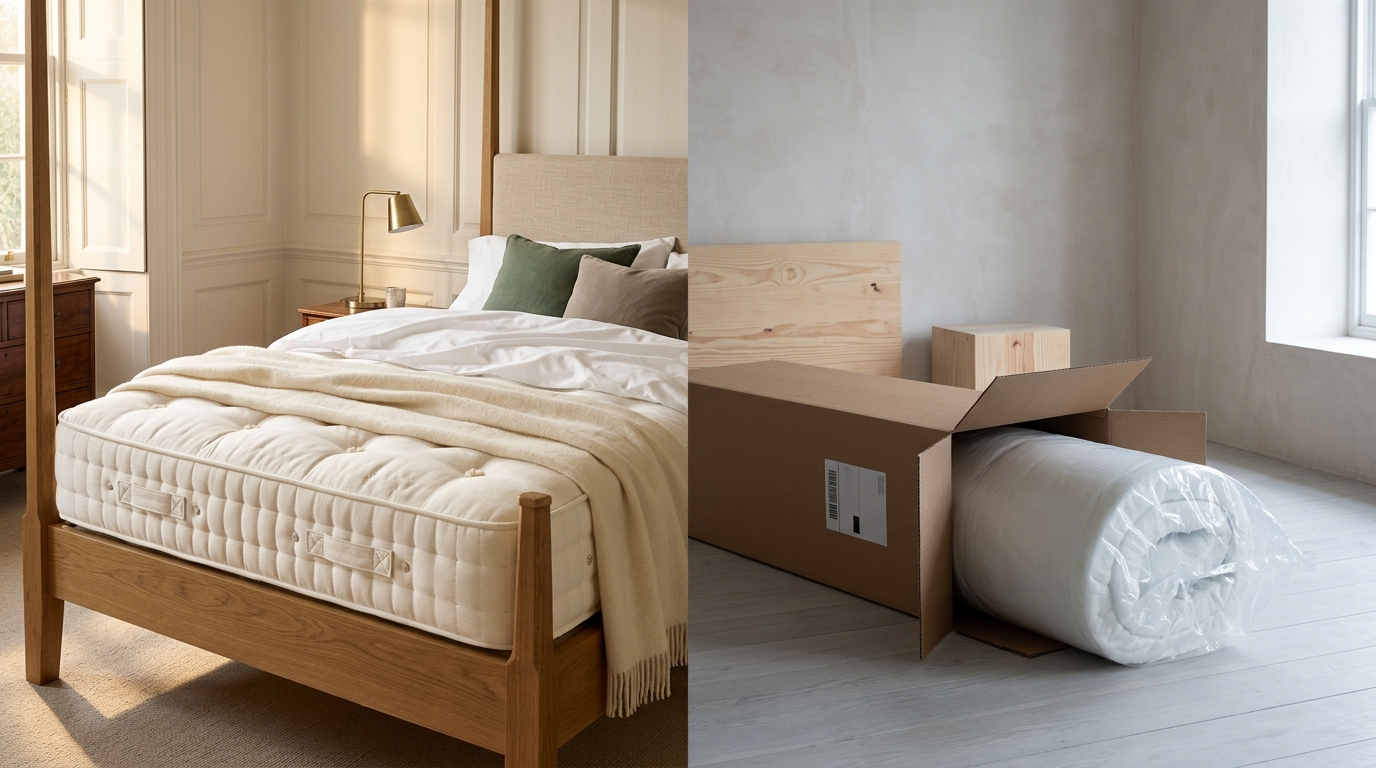

If you’re weighing up a Hypnos against an Emma, you’re not just comparing two mattresses. You’re choosing between two completely different philosophies of sleep. One is handcrafted in the UK using natural materials and pocket springs, backed by a Royal Warrant. The other arrives vacuum-packed in a cardboard box, built from synthetic foam in a factory overseas. Same bedroom, very different experience.
So which one actually deserves your money? And more importantly, which one will still feel good in five years’ time? Let’s break it down.
Key Takeaways
- Hypnos uses natural pocket springs, wool, and cotton — entirely foam-free. Emma Original is 100% synthetic foam.
- Hypnos mattresses are handcrafted in the UK with a Royal Warrant held since 1929. Emma is a German brand shipping compressed mattresses.
- Foam mattresses like Emma can show sagging within 2–3 years. Hypnos pocket-spring models routinely last 10–15 years.
- Hypnos is available through trusted UK retailers including MattressNextDay, John Lewis, Dreams, and independent bed shops. Emma sells direct-only.
- Hypnos has been carbon neutral since 2011 — the world’s first carbon-neutral bed maker.
Why Compare Hypnos and Emma?
According to SlumberSearch UK data, Hypnos scores 8.8 out of 10 for overall satisfaction, while Emma’s Trustpilot rating across 52,000+ UK reviews sits notably lower. These two brands regularly appear in “best mattress” searches, yet they couldn’t be more different in approach.
Emma has built its reputation on aggressive digital marketing, frequent sales, and a 200-night trial. It’s the mattress you see advertised on every podcast and YouTube pre-roll. Hypnos, by contrast, has built its reputation over 120 years of handcrafting beds for British homes — and for the Royal Household.
Why do people compare them? Price bracket overlap. A king-size Emma Hybrid sits around the same price as an entry-level Hypnos. But that’s where the similarities end. What are you actually getting for your money? And does the bed-in-a-box convenience justify the compromises?
How Do Hypnos and Emma Mattresses Compare on Construction?
Construction is where the gap between these two brands becomes impossible to ignore. A 2026 analysis by John Ryan By Design found that memory foam mattresses can develop permanent body impressions within 6–12 months of use — a structural issue that simply doesn’t apply to quality pocket-spring systems.
Hypnos construction: Every Hypnos mattress starts with a hand-nested pocket-spring system. Premium models feature up to 1,872 individual micro-coils, each independently responding to your body weight and movement. Choosing the right tension is key to getting this right. On top of the springs sit generous layers of natural fillings — British wool for temperature regulation, cotton for breathability, and in luxury models, materials like Himalayan allo and kapok. There’s zero foam. Zero synthetic chemicals. The whole thing is hand-tufted and hand-stitched in their Buckinghamshire factory.
Emma Original construction: The Emma Original is an all-foam mattress. Four layers of synthetic polyurethane foam and memory foam, totalling 25cm in height. There are no springs whatsoever. The comfort system uses 1.5 inches of memory foam over 1.5 inches of polyfoam, sitting on a transitional layer and a firm base foam. Emma’s Hybrid models do add pocket springs, but even those include substantial foam layers on top.
Can you feel that difference when you lie down? Absolutely. Pocket springs create a responsive, zoned support that adapts to your shape without trapping heat. Foam, by its nature, retains body heat and compresses uniformly — which is fine initially, but becomes a problem as the material degrades.
You can explore the full Hypnos range, including their Origins and Luxury collections, at MattressNextDay, where you’ll find detailed specs for every model.
Sources: John Ryan By Design (2026) | Hypnos Beds
What’s the Price Difference Between Hypnos and Emma?
Price is often the first thing people check, and at face value, Emma looks cheaper (if you want another foam vs spring comparison: Hypnos vs Tempur covers the premium memory-foam alternative). But a 2026 Bennetts Beds comparison found that traditional pocket-spring mattresses last 10–15 years on average, while all-foam beds typically need replacing after 7–10 years — and cheap foam models can deteriorate in as few as 3–5 years. That changes the maths significantly.
Let’s look at king-size prices across both ranges:
| Mattress | King Price (approx) | Est. Lifespan | Cost Per Year |
|---|---|---|---|
| Emma Original | £450 | 5–7 years | £64–£90/yr |
| Emma Hybrid | £700 | 7–8 years | £88–£100/yr |
| Emma Premium | £900 | 7–9 years | £100–£129/yr |
| Hypnos Origins 6 | £599 | 10–15 years | £40–£60/yr |
| Hypnos Orthos Support | £1,100 | 10–15 years | £73–£110/yr |
| Hypnos Luxury No Turn | £1,900 | 12–15 years | £127–£158/yr |
Here’s the thing most comparison sites won’t tell you: the cost-per-year of an entry-level Hypnos Origins 6 is actually lower than an Emma Original. You’re spending £40–£60 per year for a handcrafted, natural mattress versus £64–£90 for factory-made foam that’ll likely need replacing sooner. Is the Emma really the “budget” option?
Sources: Bennetts Beds (2026) | Luxe Mattresses
Which Gets Better Long-Term Reviews?
Customer review data tells a striking story. Emma Sleep UK has accumulated over 52,000 Trustpilot reviews, but the common complaints paint a concerning picture: sagging and dipping after 2–3 years, delivery delays, and difficult customer service. Emma’s Ireland operation sits at just 3.5 out of 5 on Trustpilot, and the CMA (Competition and Markets Authority) has previously investigated the brand.
The initial comfort of foam mattresses is rarely in question. When you first unbox an Emma, it feels plush and cradling — especially for side sleepers. But there’s a well-documented curve with all-foam beds: the material that feels so good in month one starts to compress permanently. Memory foam develops body impressions that don’t bounce back. Several Mumsnet threads and MoneySavingExpert forum posts document Emma mattresses becoming “lumpy and sunken” within two years.
Hypnos reviews tell a different story. The brand scores 8.8 out of 10 on SlumberSearch (we collate what every reviewer scores Hypnos in one place), and the complaints you do see rarely involve structural failure. Pocket springs don’t degrade the way foam does — each coil retains its tension independently, and natural wool fillings actually improve with age as they mould to your sleeping position without losing support.
Would you rather have a mattress that peaks on night one and slowly declines? Or one that breaks in gradually and stays supportive for a decade?
Who Is Each Mattress Best For?
Buyer surveys consistently show that mattress choice correlates strongly with sleeping position and body weight. A 2026 Sleep Foundation review gave the Emma Original a firmness rating of 5 out of 10 (medium), meaning it won’t suit everyone — particularly heavier sleepers or those who need firm spinal support.
Emma might suit you if:
- You’re a lightweight side sleeper who prioritises pressure relief on shoulders and hips
- You rent and move frequently (the boxed format is easier to transport)
- You want a 200-night trial to test before committing
- Budget is your absolute primary concern and you’re comfortable replacing within 5–7 years
Hypnos is the better choice if:
- You want a mattress that lasts 10–15 years without sagging
- You sleep hot — natural wool and cotton breathe far better than synthetic foam
- You’re a back or stomach sleeper who needs proper spinal alignment from pocket springs
- You share a bed and want minimal partner disturbance (individual pocket springs excel here)
- You care about what’s actually inside your mattress — natural vs chemical-based materials
- You or your partner have allergies (Hypnos uses no chemical flame retardants)
If you need a firm Hypnos mattress specifically, we’ve reviewed the best options. For king-size buyers, our Hypnos king-size guide covers every model in the range.
The Sustainability Question
Hypnos became the world’s first carbon-neutral bed maker in 2011 and has held that status for over a decade, offsetting more than 10,294 tonnes of CO2e. They hold FSC and PEFC forestry certifications, and even their packaging uses sugar-cane-based renewable materials. Every mattress is 100% recyclable.
Emma’s environmental story is harder to verify. Synthetic polyurethane foam is a petroleum-derived product. The vacuum-packed, compressed shipping model does reduce transport emissions per unit — that’s a genuine advantage. But the foam itself isn’t biodegradable, and when an Emma mattress reaches end of life in 5–7 years, it’s heading to landfill unless you arrange specialist recycling.
Does sustainability factor into your mattress decision? For a growing number of UK buyers, it does. And on this front, it’s not even close. Hypnos doesn’t just talk about sustainability — they’ve been independently certified for it since before “bed-in-a-box” was even a category.
Sources: Hypnos Beds — Carbon Neutral | Dreamers Bed Centre
Where to Buy: Retailer Options Compared
Here’s a practical difference that doesn’t get enough attention. Hypnos sells through established UK mattress retailers, meaning you can try before you buy, compare models side-by-side, and get expert advice. Emma sells almost exclusively through its own website — direct-to-consumer only.
Hypnos sells through established UK retailers including John Lewis, Dreams, Bensons for Beds, and online specialists. One option we consistently recommend is MattressNextDay, which carries the full Hypnos range. Key benefits:
- Expert guidance: MattressNextDay staff can help you choose between Hypnos models based on your sleep style, weight, and preferences
- Price matching: Competitive pricing with regular offers on Hypnos stock
- Fast UK delivery: Next-day delivery available on many models
- Returns you can trust: Established retailer with a clear returns process
With Emma, you’re dealing with the brand directly. If something goes wrong — and the Trustpilot complaints suggest it sometimes does — you’re navigating their customer service alone. Multiple reviewers report chatbots that don’t resolve issues, unreachable phone lines, and refund delays.
For more on the best Hypnos deals through MattressNextDay, see our dedicated buying guide. We’ve also compared Hypnos vs Silentnight and Hypnos vs Vispring if you’re weighing other options.
Our Recommendation: Hypnos Wins This Comparison
If you’re choosing between Hypnos and Emma, we’d pick Hypnos every time. You’re getting handcrafted British quality, natural materials, superior longevity, and genuine sustainability credentials. The entry-level Hypnos Origins 6 costs less per year of use than an Emma Original — and it’ll feel better for longer.
Emma isn’t a bad mattress for the first year or two. But when you factor in foam degradation, synthetic materials, and a direct-only sales model with inconsistent customer service, the value proposition falls apart.
Frequently Asked Questions
Is Hypnos really worth the extra money over Emma?
When you calculate cost-per-year, an entry-level Hypnos Origins 6 (around £599 for a king) actually costs less than an Emma Original over its lifetime. The Hypnos will last 10–15 years versus 5–7 for the Emma. You’re paying more upfront but spending less in the long run — and sleeping on natural materials the entire time. You can check current Hypnos pricing at MattressNextDay.
Does the Emma mattress sag over time?
Yes, this is the most common complaint. Thousands of reviews report sagging and dipping after 2–3 years. Memory foam naturally compresses with use, and once body impressions form (typically within 6–12 months), they’re permanent. Emma’s warranty covers sags greater than 2.5cm, but standard softening isn’t classified as a defect. Hypnos pocket springs, by contrast, retain their tension independently and don’t develop the same compression issues.
Can I try a Hypnos mattress before buying?
Yes. Unlike Emma (which is online-only), Hypnos mattresses are available through UK retailers where you can lie on them in person. MattressNextDay carries the full range and offers expert advice to help you choose the right firmness and model for your sleeping style. Emma does offer a 200-night home trial, but you’ll need to wait for delivery, unbox it, and go through a returns process if it doesn’t suit you.
Are Hypnos mattresses good for back pain?
Hypnos is one of the strongest choices for back pain sufferers. Their pocket-spring systems provide zoned support that maintains spinal alignment — something all-foam mattresses struggle to do consistently as the foam softens over time. If you need targeted back support, look at the firmer Hypnos models in their range. Our Hypnos care guide also covers positioning and maintenance tips to maximise back support.
The Bottom Line
This comparison comes down to a simple question: do you want convenience or quality? Emma delivers a decent first impression — affordable, quick to arrive, comfortable out of the box. But it’s a mattress designed for a transaction, not a relationship.
Hypnos builds mattresses designed to last. Natural materials, hand-tufted construction, pocket springs that adapt without degrading, and a carbon-neutral production process that’s been independently verified for over a decade. Read our full Hypnos mattress review for the complete breakdown. It’s the kind of mattress your parents would have bought — except better, because the engineering has improved while the craftsmanship has stayed the same.
If you’re spending a third of your life on something, it’s worth getting right. We’d choose Hypnos, and it’s available at MattressNextDay.